
How to read and listen to Chinese with pinyin support
Website
Use one short passage for reading, listening and vocabulary practice. Laowai’s public reading library includes text support and recording controls where audio is available.
Choose by difficulty and available support
Open Readings and filter by topic, format, level source or audio availability. A level can come from a source collection or Laowai’s editorial guidance. Check that label when choosing material, especially if you need a specific HSK syllabus.
Start with a passage where you can follow the situation after a few lookups. A short dialogue about ordering tea may give you more useful listening practice than a long text that requires translating every sentence.
The public library and your private imported books are separate destinations. You can read a public passage without uploading a file.
Read once, then reveal the help you need
- Open the reading and read the Chinese first.
- Use the Pinyin control when pronunciation prevents you continuing.
- Reveal the translation for a sentence you cannot follow, then return to the Chinese.
- Choose simplified or traditional characters where the page offers that control.
- Check a word through the reading’s dictionary tools and return to the sentence.
Try a concrete question while reading: Who wants tea? Where is the book? Why does the plan change? You then have a reason to follow the passage instead of inspecting isolated words.
你想喝茶还是咖啡?
Nǐ xiǎng hē chá háishi kāfēi?
Would you like tea or coffee?
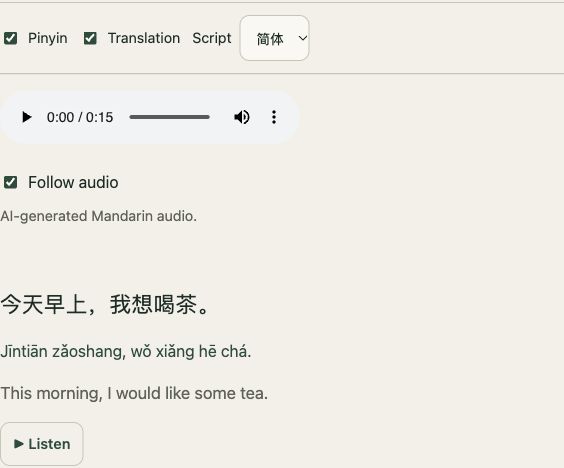
Use the recording attached to the reading
When a passage includes audio, use its full or section recording controls. Follow audio highlighting where available, then listen again while reading fewer hints. Some materials provide a complete recording; others provide recordings for particular sections.
Read the local audio label and source credit. The library includes different sources, and generated Mandarin audio is labelled on the relevant material. A browser’s Listen command in your private reader uses a different speech route from a published source recording.
A useful second pass is to listen for one phrase, pause, and say what it means. Then replay the whole sentence so the phrase stays connected to its context.
Answer the question and keep useful words
Complete the reading’s comprehension activity when one is included. Find evidence in the text before checking. A correct vocabulary translation alone may not answer who did what in the story.
Use Save words to My lists or Practise these words where offered. Choose the vocabulary you actually needed, then return to reread the passage after practice. Word progress is shared with your other lists.
The Open this reading in Laowai action requires a compatible updated app reader. A TXT download offers another route for importing the Chinese text. Your website reading controls, imported text and app edition can have different available support; inspect the actual destination after opening it.